


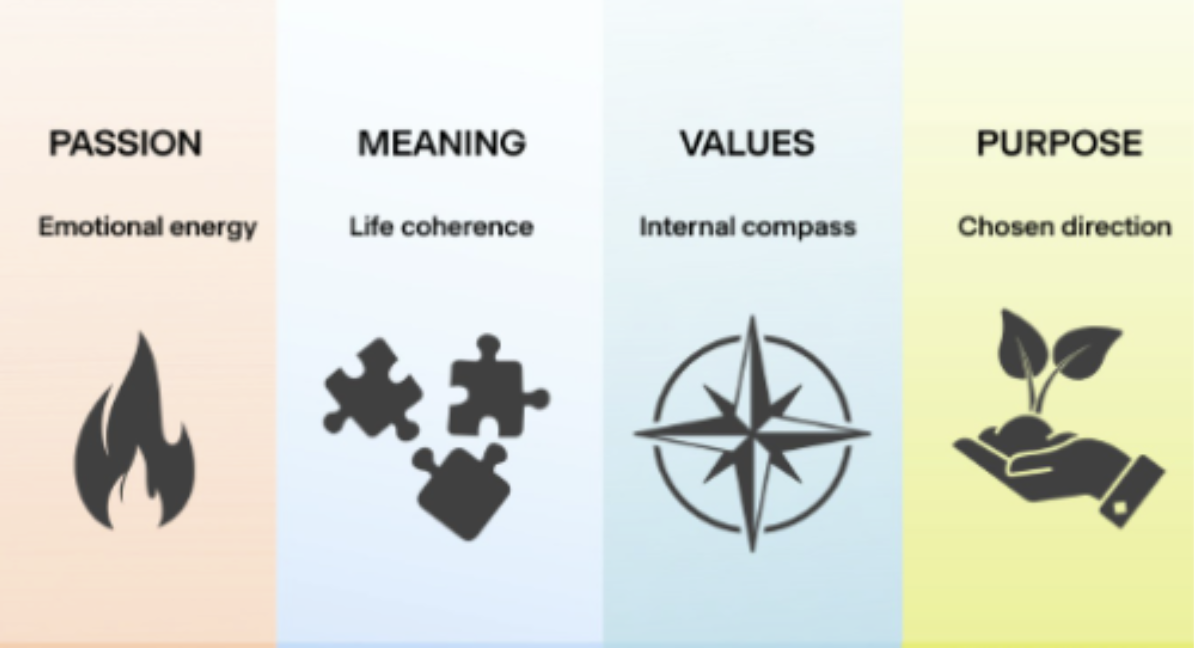
So here's the challenge I'm now posing to every student applying or preparing to apply for college this cycle: How much of what you think is your "purpose" is actually college-pleasing in disguise?
How much of your direction is influenced by:
- What will impress admissions officers?
- What your parents expect or want for you?
- What your high-achieving friends are doing?
- What your competitive environment tells you "successful people" pursue?
How much have you actually reflected on what matters to you—independent of external validation?
Because here's what I've learned: Students who develop authentic purpose don't just write better essays (though they often do). They build resilience for when college gets hard—and it will get hard.
WITHOUT PURPOSE: "I failed organic chemistry → I'm not cut out for pre-med → My life is over → Should I even be here?" → Rumination, despair, paralysis
WITH PURPOSE: "I failed organic chemistry → This is hard, but it's hard for a reason → What do I need to change? → Still building toward serving rural patients like my grandmother" → Reframes obstacle as worthwhile challenge to overcome
Same setback. Different story. Different outcome.
Here's an actual purpose example with one of my current students:
After some conversations and back & forth, we defined it roughly as "The Borderless Community Builder." Here's some context on how we identified her purpose.
This student's ultimate dream is to be an astronaut - the unfortunate part is that she currently just barely falls short of the minimum height requirement. Needless to say, this really sucks big-time and this potential exclusion is a very difficult feeling for her to process and imagine.
However, the meaningful story we began to create together was inspired by the ideal vision of an astronaut's view of Earth from space - seeing it without artificial divisions.
This is the core purpose driving multiple activities and pursuits for her - whether its teaching English to Turkish immigrants to erase language barriers or (hopefully) eventually overcoming the height restriction requirement, this is her "why" behind the how.
So to concisely summarize her purpose insight: "To create inclusive communities where borders don't matter—from language barriers to planetary boundaries—so belonging isn't determined by arbitrary lines we're born or forced into."
But don't just take my word for why this matters, here's what my Berkeley AO friend Andy said in an admissions webinar we co-hosted this weekend:
"Here's what I want to put in perspective about the college admissions process:
You can't control what the other 100,000 applicants look like. You can't control their test scores, their GPAs, or their activities. What you CAN control is putting together the most thoughtful application possible—one that helps admissions officers know you as a person, independently of those other applicants.
When you've done this purpose reflection work, you're not just listing accomplishments—you're revealing WHO YOU ARE. You're showing us the patterns, the purpose, the authentic story that makes you different from everyone else in the pile. That's your best foot forward. That's how you stand out."
— Andy Nguyen, Senior Assistant Director of Admissions, UC Berkeley
Request Your Free Purpose Playbook
[FILL OUT THIS BRIEF 10-MINUTE FORM] → You'll receive your starter purpose playbook within 48 hours!
Here's What Happens If You Do!
Step 1: Request Your Free Starter Kit (Only takes 10 min of your time)
Step 2: Get Your Personalized Analysis (Within 48 hours)
I'll send you:
- Your Purpose Playbook (including passion, meaning, values & purpose insights) based on what you shared
- One personalized reflection question for each section to continue reflection process onyour own
- Suggest next steps on how to go deeper and build out your full college purpose playbook
Look, I'm not going to sugarcoat this: finding honest answers to these purpose questions is hard work.
When I ask students "what energizes you?" most freeze. When I ask "what's the pattern connecting your activities?" they draw a blank. These questions don't have easy answers—and that's exactly the point.
But here's what I've learned working with over 100 students: The ones who lean into this difficulty? They're the ones who write essays that make admissions officers remember them. They're the ones who choose colleges that actually fit. They're the ones who show up freshman year knowing why they're there.
The work matters. It's just really hard to do alone.
I wish someone had asked me these questions back then. I wish someone had helped me see the patterns I couldn't see myself.
So let's do this together. You don't have to figure this out alone!
-Fei
